Homes in Melbourne built before 1970, and especially before 1965, very likely contain lead-based paint on weatherboards, window frames, doors, eaves and trim, and managing it safely typically adds about $1,500–$4,000 to a repaint in 2026. WorkSafe Victoria confirms that paint with a high lead content was used on many buildings constructed before 1970, and that this paint only becomes a serious health risk when it deteriorates or is disturbed by sanding (WorkSafe Victoria).
We’ve been painting Melbourne homes since 1987, that’s more than three decades and more than 1,000 residential projects, a great many of them on the pre-1970 weatherboard and brick homes that fill inner-Melbourne suburbs. This guide explains who’s affected, what safe handling actually costs, and the one thing you must never do yourself.
Does my pre-1970 home have lead paint?
Very likely yes, particularly if your home was built before 1965 and still carries any original paintwork.
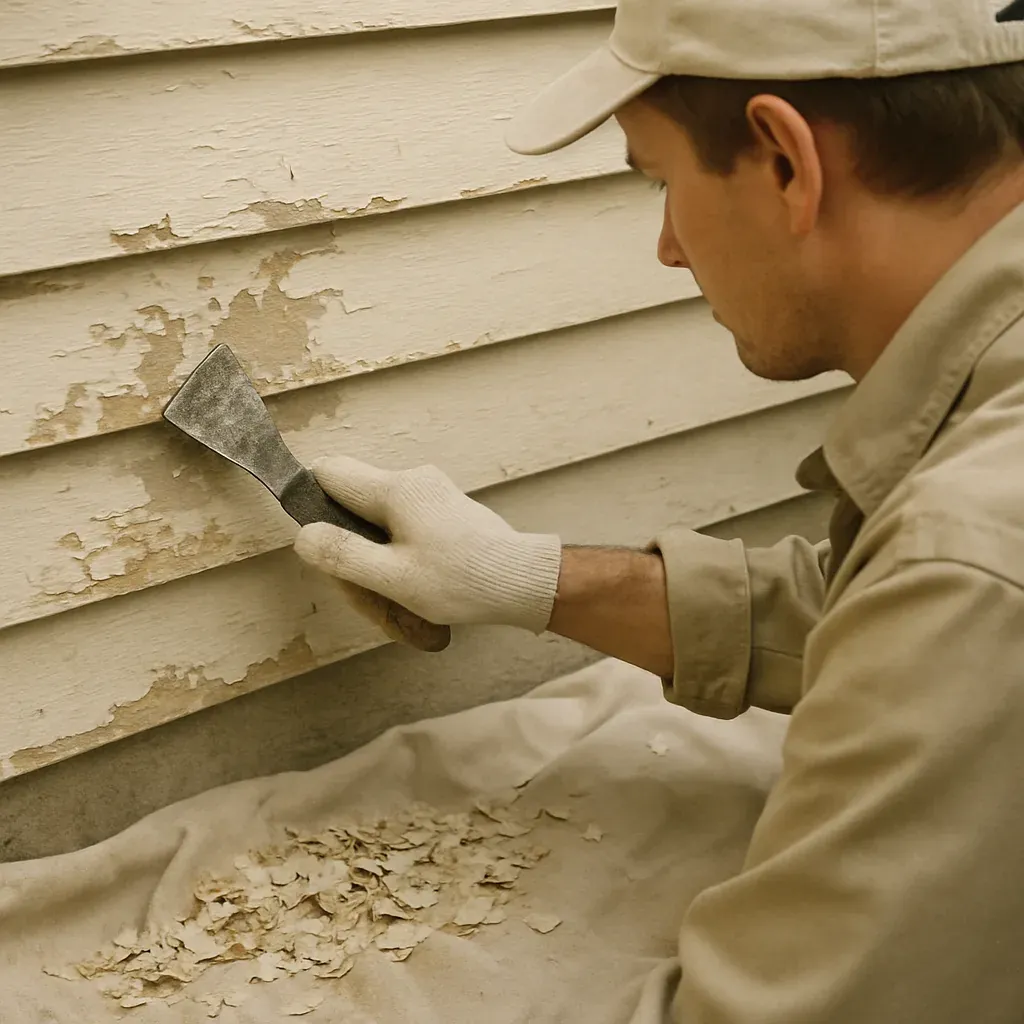
Lead was a standard ingredient in Australian house paint for decades. Homes built before 1970 are highly likely to have it somewhere, and the older the home, the higher the lead content tends to be. The Australian Government’s Lead Alert: The Six-Step Guide to Painting Your Home notes that lead-based paint was used in many Australian homes built before 1970, and that even small amounts of dust or paint chips generated during minor repairs can be a health risk.
In Melbourne, the suburbs most affected are the older inner and middle-ring areas, places like Footscray, Yarraville, Brunswick, Northcote, Coburg, Williamstown, Richmond and Fitzroy, where Victorian, Edwardian, Federation and early post-war weatherboard and brick homes are common. The lead is usually concentrated on:
- Weatherboards and exterior cladding
- Window frames and sashes
- Doors and door frames
- Eaves, fascia and barge boards
- Skirting boards, architraves and other trim
If your home is pre-1970 and has never been fully stripped back, assume lead paint is present until a test proves otherwise.
Key takeaway: Treat every pre-1970 Melbourne home as containing lead paint until a test confirms it doesn’t. Testing first is cheap insurance against an expensive and dangerous mistake.
Why is lead paint dangerous?
Lead paint is only dangerous when it’s disturbed, sanding, scraping or burning it off releases toxic lead dust and fumes.
This is the most important thing to understand. A wall of sound, intact lead paint sitting quietly on your weatherboards is generally not poisoning anyone. The danger appears the moment that paint is disturbed and turned into fine dust or fumes. WorkSafe Victoria states that lead-based paint presents a health risk when it deteriorates and becomes powdery or flaky, or when sanding and buffing produces lead dust (WorkSafe Victoria).
Lead dust is invisible, settles on floors, soil and surfaces, and is easily ingested or inhaled, which is why children and pregnant women are most at risk. Health authorities note that lead exposure can cause irreversible harm to a child’s developing brain and nervous system, and in adults can affect the nervous and reproductive systems and raise blood pressure.
That’s why a careless DIY sand-back of an old Melbourne weatherboard isn’t just messy, it can contaminate your home, your garden and your family.
Can I sand or burn it off myself?
No, never dry-sand, power-sand or burn off suspected lead paint yourself.
Of everything in this guide, this is the rule that matters most. Power-sanding an old weatherboard, taking an angle grinder or a heat gun to flaking paint, or dry-scraping window frames are exactly the activities that generate the most dangerous lead dust and fumes. A weekend of DIY prep on a pre-1970 home can spread lead contamination through your soil, your floors and your roof cavity that is difficult and costly to clean up.
If old paint genuinely needs to come off, it must be done by methods that keep dust down and contained, wet-sanding, wet-scraping or chemical stripping, with proper protective equipment, plastic containment and thorough HEPA-vacuum clean-up afterwards. This is specialised work, not weekend work.
Key takeaway: Never dry-sand, power-sand, grind or burn off suspected lead paint yourself. If you do nothing else from this article, do this. Test first, and if lead is present, get a competent contractor to handle removal.
Can you paint over lead paint?
Often, yes, if the existing lead paint is sound and intact, it can usually be cleaned, lightly prepared and painted over safely.
This surprises a lot of homeowners who assume lead paint always has to be fully stripped. It doesn’t. Where the old paint is well-adhered and not flaking, the safest and cheapest path is usually to leave it undisturbed, give it gentle preparation that doesn’t create dust, prime appropriately and paint over the top with a quality Dulux system. The intact lead is then sealed beneath new coats.
Full removal is only necessary where the old paint is actively failing, flaking, peeling, blistering or powdery, because you can’t get a durable new finish over paint that’s letting go of the surface. In that case the failing paint has to come off, and it has to come off safely.
The right approach depends entirely on the condition of your existing paint, which is why an on-site assessment matters. We work this out at the quote stage and tell you plainly which areas can be over-coated and which need removal.
“On most pre-1970 Melbourne homes we don’t strip everything back, we test, we keep sound paint sealed under new coats, and we only remove what’s actually failing. That’s safer for your family and cheaper for you.”, Modernize Solutions, painting Melbourne homes since 1987
How much does lead paint removal cost in Melbourne?
Safe management or removal of lead paint typically adds about $1,500–$4,000 to a Melbourne painting job in 2026, depending on how much is present.
That additional cost covers the things that make lead work safe and compliant: plastic sheeting and containment, drop sheets to capture every chip, wet-sanding or chemical stripping rather than dry methods, respirators and disposable protective equipment, HEPA-vacuum clean-up, and lawful disposal of lead-contaminated waste. None of that is optional, and none of it is cheap, but it’s a fraction of the cost of cleaning up a contaminated property or harming your family’s health.
Where your job lands in that range depends on extent:
| Extent of lead paint | Typical added cost (2026) | What’s involved |
|---|---|---|
| Minor, trim, a few window frames | ~$1,500–$2,000 | Spot containment, wet-prep, careful clean-up |
| Moderate, multiple failing areas | ~$2,000–$3,000 | Larger containment, mix of over-coat and removal |
| Extensive, widespread peeling weatherboards | ~$3,000–$4,000+ | Full containment, significant stripping, disposal |
This is a major reason older-home repaints in Melbourne quote higher than newer homes, and it’s a legitimate cost, not a markup. Always get a written quote that states clearly how lead paint will be tested for and handled. Consumer Affairs Victoria advises homeowners to insist on detailed, itemised quotes that specify exactly what is and isn’t included before agreeing to any work (Consumer Affairs Victoria).
Key takeaway: Budget roughly $1,500–$4,000 on top of a standard repaint for safe lead paint handling on a pre-1970 Melbourne home, and make sure your written quote spells out the method.
How do I test for lead paint?
Inexpensive lead test kits are widely available from hardware stores, and a small number of layers can be sent to a lab for confirmation.
Home lead test kits, typically a swab that changes colour in the presence of lead, cost only a few dollars and give a quick first answer on whether a surface contains lead. They’re cheap insurance: a few dollars spent before you touch a sander can save you from a contamination problem worth thousands. For a definitive result, a paint sample can be sent to a laboratory for analysis.
Practically, if your home is pre-1970, a positive test simply confirms what you should already assume. The value of testing is in identifying which specific surfaces carry lead and how heavily, so the safe-handling plan and the quote are accurate rather than guesswork. We can advise on testing as part of the quote process.
What does safe lead paint removal actually involve?
Safe removal means containing the area, working wet to suppress dust, using protective equipment, then HEPA-cleaning and disposing of waste lawfully.
A competent contractor doesn’t just turn up with a sander. Safe lead paint work on a Melbourne home follows a clear sequence:
- Test and assess, confirm where lead is present and how the paint is performing.
- Contain, plastic sheeting, drop sheets and isolation so dust and chips can’t spread into soil or living areas.
- Remove without dust, wet-sanding, wet-scraping or chemical stripping rather than dry-sanding or burning.
- Protect people, respirators, disposable coveralls, gloves and safe footwear for anyone doing the work.
- Clean up thoroughly, HEPA vacuuming and wet wiping, not dry sweeping which just re-suspends the dust.
- Dispose lawfully, lead-contaminated waste collected and disposed of correctly, not tipped in your wheelie bin.
This mirrors the safe-work approach set out by WorkSafe Victoria and the federal Lead Alert guide, and it’s why the work costs more than ordinary prep. It’s also why it shouldn’t be DIY.
Why does lead paint make my quote higher?
Because safe handling adds genuine labour, materials, equipment and disposal costs that newer homes simply don’t have.
If you’ve been comparing your pre-1970 weatherboard against a friend’s 2005 brick home and wondering why your quote is higher, lead paint is often a big part of the answer. The containment, the slower wet-working methods, the protective gear and the special waste disposal all add real hours and real cost. It sits alongside the other classic older-home cost-modifiers, failing render, rotten timber, heritage detailing and difficult access.
The honest painters will name it on the quote. The cheap operators will either ignore it, and quietly dry-sand your lead paint anyway, putting your family at risk, or “discover” it mid-job and add cost later. A written, itemised quote that addresses lead paint upfront is the best protection you have.
“When a quote for an old Melbourne home doesn’t mention lead paint at all, that’s not a saving, it’s a warning sign. Either they haven’t looked properly, or they’re planning to dry-sand it and hope you don’t ask.”, Modernize Solutions
Which Melbourne homes are most affected?
The older the home, the higher the likelihood and concentration of lead paint.
Use this as a rough guide to where your home sits:
| Home era | Lead paint likelihood | What it means for your repaint |
|---|---|---|
| Before 1950 | Very high | Assume lead on most original paintwork; plan for safe handling |
| 1950–1969 | High | Lead likely on trim, windows, weatherboards; test before prep |
| 1970–1989 | Lower but possible | Lead use declining; test older layers if disturbing them |
| 1990 onwards | Very low | Lead largely phased out; standard prep usually fine |
Because the heavily affected eras line up with so much of Melbourne’s inner and middle-ring housing stock, lead paint is a routine consideration on our exterior and weatherboard jobs, not a rare exception.
How do you book a quote with Modernize Solutions?
Call 0451 040 396 for an on-site assessment of your pre-1970 home, including a clear plan and written quote for how any lead paint will be tested and safely handled.
Lead paint is one of the main reasons older Melbourne homes need an experienced, honest painter rather than the cheapest quote. The work has to be done safely, the failing areas have to be identified correctly, and the sound areas should be sealed rather than needlessly stripped. That balance comes from experience on exactly this kind of housing.
Modernize Solutions is family-owned and has been painting Melbourne homes since 1987, more than three decades and more than 1,000 residential projects, a large share of them on pre-1970 weatherboard and brick homes. We use Dulux premium paint systems exclusively, carry $20 million public liability insurance, and back our work with a workmanship guarantee, if there’s ever an issue with our work, we come back and fix it at no cost. We hold a 4.8-star Google rating from 154 verified reviews, and the owner personally conducts every quote, so you get a straight answer on lead paint, not a sales pitch. Call us on 0451 040 396.
If you’re planning to repaint an older home, don’t pick up a sander first. Get it assessed, get it in writing, and get it handled safely.
Frequently asked questions
Does my pre-1970 Melbourne home have lead paint?
Very likely, especially if it was built before 1965. Lead-based paint was common on Australian homes built before 1970, particularly on weatherboards, window frames, doors, eaves and trim. Inner-Melbourne suburbs have a large stock of this older housing. A cheap lead test kit confirms it before any sanding or scraping begins.
How much does lead paint removal add to a painting job in Melbourne?
Safe management or removal by a competent contractor typically adds about $1,500–$4,000 to a Melbourne painting job in 2026, depending on how much lead paint is present and how it is handled. This covers containment, wet-sanding or chemical stripping, HEPA clean-up, protective equipment and safe waste disposal. Your written quote should state exactly how lead paint will be managed.
Can I sand or burn off lead paint myself?
No. Never dry-sand, power-sand or burn off suspected lead paint yourself. These methods create toxic lead dust and fumes that are a serious health risk to children and pregnant women. Intact, well-maintained lead paint is generally only dangerous when disturbed. If old paint must be removed, use a competent contractor who works wet and contains the dust.
Can you paint over lead paint instead of removing it?
Often, yes. If existing lead paint is sound, intact and well-adhered, it can usually be cleaned, lightly prepared and painted over safely without full removal, this is frequently the safest and cheapest option. Removal is only needed where the old paint is flaking, peeling or failing. A site assessment determines which approach suits your home.
Related Service: Exterior Painting
Weatherboard, render and brick exteriors prepped, repaired and repainted to handle Melbourne weather.
Learn more about our Exterior Painting service →
Owner & Lead Painter · Modernize Solutions · Painting Melbourne homes since 1987