Professional painters near Altona typically charge $6,000–$10,000 for a full exterior repaint of a single-storey bayside bungalow in 2026, with coastal-grade Dulux Weathershield paint systems that last 8–10 years in salt-spray conditions. Altona sits on Port Phillip’s shoreline, which is beautiful for residents and brutal for paint. Salt-laden wind, high humidity, temperature swings, and UV exposure create conditions that break down standard exterior finishes in years, not decades. If you own a weatherboard or brick home in Altona, your exterior painting challenge is real—but it’s manageable if you know what you’re doing.
Modernize Solutions is a Melbourne painting company established in 1987 that has been painting Altona homes for over 35 years. The company holds $20M public liability insurance, maintains a 4.8-star Google rating across 154 reviews, and uses Dulux premium paint systems exclusively on every residential project across Melbourne’s western suburbs.
[NEEDS QUOTE: Coastal paint specialist on salt spray damage patterns in bayside Melbourne suburbs]
We’ve seen what works and what fails in bayside conditions. We’ve learned which paint systems hold up, which corners are genuinely worth cutting and which aren’t, and how to keep a coastal home protected without repainting it every four years.
Why Does Altona’s Coastal Environment Affect Paint So Badly?
Salt spray, high humidity, UV reflection off water, and temperature swings break down standard exterior finishes in years, not decades.
Altona’s position on Port Phillip creates a specific set of challenges. Salt spray travels inland—not just immediately at the shoreline, but several kilometres inland. The salt settles on surfaces, finds its way into paint films, and works from the inside out. You can’t see it happening, but it’s happening.
Humidity is higher in Altona than inland. Morning condensation is heavier, drying is slower, and moisture lingers on surfaces longer. If your exterior paint film isn’t properly sealed and protected, moisture penetrates behind it. This causes peeling, blistering, and paint failure years before you’d expect.
Temperature swings are more dramatic at the coast than inland—your house experiences constant contraction and expansion. Paint films that are brittle fail under this stress. Paint films that are flexible survive. It’s a technical detail, but it matters.
Finally, there’s UV exposure. The sun reflects off the water, intensifying UV damage. Standard interior-grade paint exposed to this will fade and degrade rapidly. You need exterior paint formulated for this specific stress—and in Altona, you need premium exterior paint.
What Makes Weatherboard Homes the Biggest Painting Challenge in Altona?
Weatherboard is porous timber that absorbs and releases moisture seasonally — when paint fails, moisture penetrates and causes structural damage.
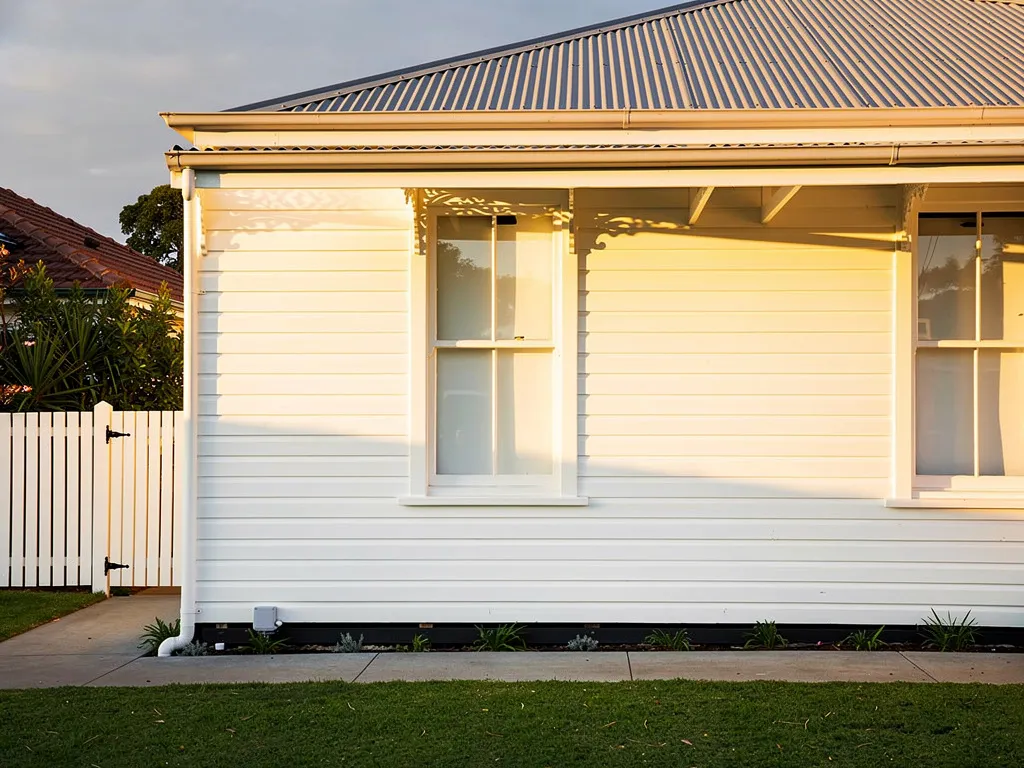
Most Altona homes built before 1990 are weatherboard. It’s the classic bayside bungalow aesthetic: single-storey, broad verandas, shallow pitch roofs, timber weatherboards painted in cream or pale colours. These homes are charming. They’re also exposed to everything.
Weatherboard is porous timber. It absorbs and releases moisture with seasonal changes. When paint fails on weatherboards, it’s usually because moisture has penetrated behind the film. The paint peels, the wood is exposed, moisture accelerates the deterioration, and suddenly you’ve got a structural problem.
Key takeaway: According to Dulux Australia, Weathershield exterior paint contains flexible binders specifically engineered to resist salt spray and UV damage in coastal environments like Altona, outperforming standard acrylics by 3–5 years.
This is why we don’t recommend standard acrylic paint for Altona weatherboards. We specify Dulux Weathershield—it’s a premium exterior system designed for exactly these conditions. Weathershield is formulated with flexible binders that move with timber expansion and contraction. It resists salt spray, it stretches without cracking, and it holds up in coastal environments.
Weathershield typically costs 30–40% more than budget exterior paint. In Altona’s conditions, that’s money you save because you won’t be repainting every three years. The warranty tells you something: we warranty Dulux Weathershield exterior work for three years. Standard products? We might only warranty for two years, because we know they fail faster.
Where Do Most Exterior Paint Failures Actually Start?
Preparation. A typical Altona bungalow needs 40-60 hours of scraping, rot treatment, and priming before a single coat of finish paint.
Here’s what separates professional work from DIY attempts in coastal homes: prep work.
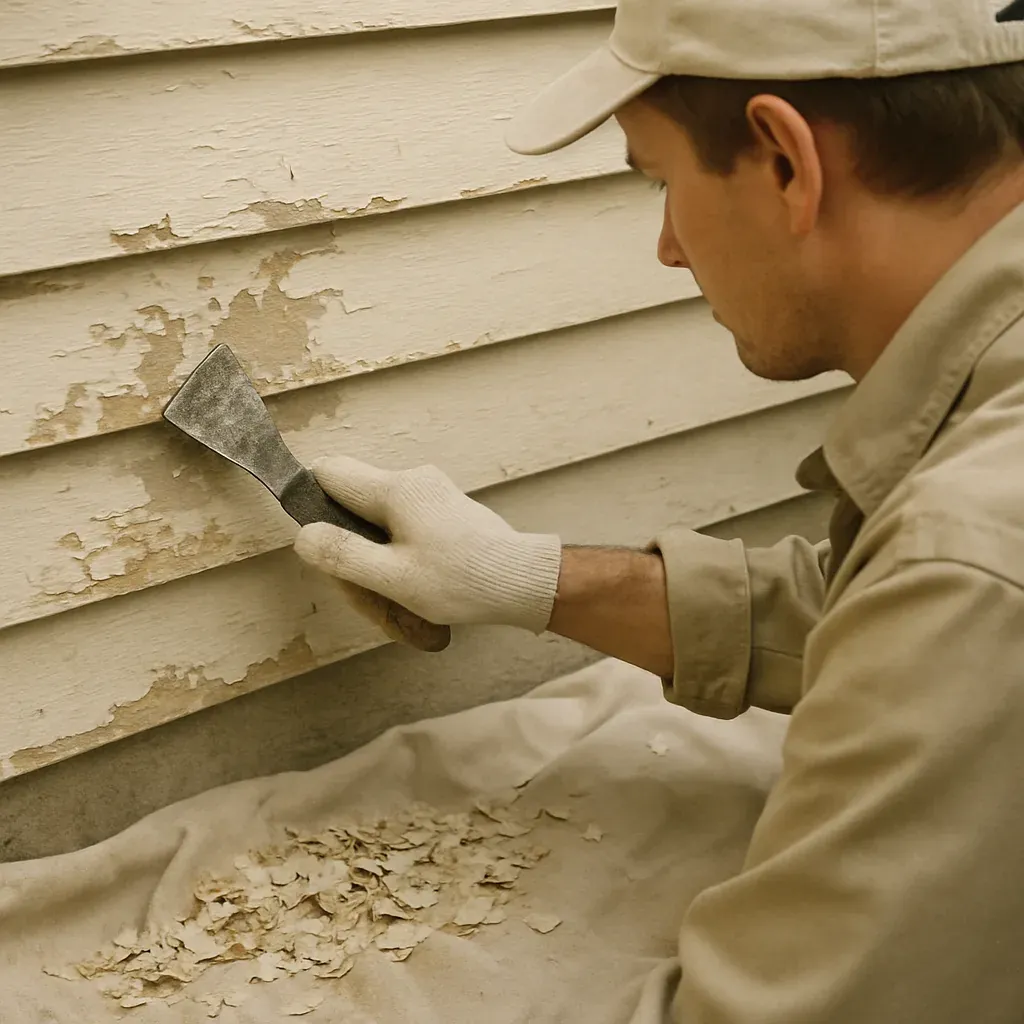
If your Altona weatherboard home needs repainting, the existing paint is usually failing or degraded. You can’t paint over failure. You have to fix it first. That means scraping back to sound timber, identifying rot, treating rot, replacing damaged boards, filling gaps, sanding, and priming.
This is labour-intensive. A typical Altona bungalow might need 40–60 hours of prep before a single coat of finish paint goes on. That’s why exterior painting costs what it does. Most of the expense is preparation, not paint.
In coastal conditions, prep is even more critical. Salt residue needs to be washed off. Moisture in the timber needs to dry completely. Any weakened paint needs to come off. The substrate needs to be absolutely sound before protection goes on.
We typically do a full power wash of salt-affected areas, let everything dry for 2–3 days, then sand back to sound paint or timber. It’s meticulous, but it’s the difference between a three-year job and a ten-year job.
Key takeaway: Proper exterior preparation on an Altona bungalow requires 40–60 hours of scraping, rot treatment, and priming — accounting for roughly 60–70% of total project cost, as recommended by Master Painters Australia.
How Should Brick Homes in Altona Be Painted Differently?
Brick needs breathable paint that lets moisture vapour escape. We recommend Dulux Weathershield in satin or flat — never high-gloss in coastal areas.
Altona’s newer homes (1970s onward) are often brick veneer—modern construction, solid, fewer moisture issues than weatherboard. But brick isn’t immune to coastal conditions. Salt penetrates mortar, salt deposits on brick surfaces, salt works into the paint film.
For brick homes in Altona, we recommend Dulux Weathershield as well. It breathes—allows moisture vapour to escape without trapping moisture behind the film—while still providing a protective seal against salt spray.
We generally don’t recommend high-gloss finishes on brick in coastal areas. The glossy film traps moisture. Satin or flat finishes allow the surface to breathe better and perform more reliably in humid conditions.
Brick also needs different prep than timber. You can’t sand brick. You power wash, let it dry, fill any mortar gaps, and check for salt efflorescence. If white salt deposits are visible on the brick, they need to be removed before painting—they prevent adhesion.
How Does Salt Spray Cause Paint to Fail?
Salt compounds under the paint film draw moisture in, causing blistering that grows over weeks and eventually exposes the timber underneath.
This is technical, but it matters: salt spray failure looks different from standard paint failure. Instead of uniform peeling, you get blistering—the paint film bubbles up, usually from the back, as salt compounds underneath draw moisture into the film. The blisters grow over weeks or months, eventually breaking open and exposing timber beneath.
This is why coastal paint systems need to be selected specifically for salt exposure. The film needs to be thick enough, flexible enough, and have sufficient salt resistance to protect against this specific mechanism of failure.
Standard acrylic paint fails here because the film is too thin and too brittle. Dulux Weathershield’s thicker, more flexible film resists blistering. We typically apply Weathershield in two full coats—that’s roughly 150–200 microns of total film thickness. That matters.
Does Coastal Humidity Affect Interior Painting in Altona?
Yes — moisture builds up in older weatherboard homes with poor ventilation, causing blistering, peeling, and mould on interior walls.
Humidity affects interiors too, especially in older weatherboard homes where ventilation isn’t great. Moisture builds up, paint can blister or peel on interior walls, and mould can become an issue.
For Altona interiors, we usually recommend Dulux Aquanamel in bathrooms and moisture-prone areas. For living spaces, standard Dulux Wash & Wear is fine if the home has decent ventilation. But if you’re noticing moisture problems, we’ll recommend Aquanamel throughout to prevent future issues.
The trade-off: Aquanamel is slightly more expensive than standard acrylic, but it’s insurance against moisture problems in a coastal environment.
What Does Exterior Painting Cost for an Altona Home?
A full exterior refresh on a single-storey bungalow runs $6,000-$10,000 with Dulux Weathershield; two-storey homes are $8,000-$13,000.
For a typical single-storey Altona bungalow (say, 150–180 square metres of paintable area), expect:
- Full exterior refresh with prep: $6000–$10,000 using Dulux Weathershield
- Spot repairs and repainting (existing paint in reasonable condition): $4500–$7000
- Roof repainting (if needed): add $1500–$3000
| Project type | Typical cost range | Paint system | Expected lifespan |
|---|---|---|---|
| Single-storey full exterior | $6,000–$10,000 | Dulux Weathershield | 8–10 years |
| Two-storey full exterior | $8,000–$13,000 | Dulux Weathershield | 8–10 years |
| Spot repairs and repaint | $4,500–$7,000 | Dulux Weathershield | 6–8 years |
| Interior living areas | $3,000–$5,000 | Dulux Wash & Wear | 7–10 years |
| Interior bathrooms/wet areas | $1,500–$2,500 | Dulux Aquanamel | 5–7 years |
| Roof repaint (add-on) | $1,500–$3,000 | Dulux roof membrane | 8–10 years |
A two-storey home will be higher—maybe $8000–$13,000 for a full refresh—because the preparation and application are more time-consuming and require additional safety measures.
These aren’t cheap jobs, but coastal conditions demand quality. We’ve seen too many Altona homeowners attempt budget painting, watch it fail in two years, and then pay more to redo it properly.
Timeline: expect 3–4 weeks from start to finish for a full exterior. Preparation typically takes 2 weeks, application 1 week. Weather affects this—we won’t paint in rain or high wind, and coastal weather can be unpredictable.
Key takeaway: A full exterior repaint of an Altona bungalow with Dulux Weathershield costs $6,000–$10,000 and takes 3–4 weeks, but provides 8–10 years of coastal protection compared to 3–4 years from budget paint systems.
When Is the Best Time to Paint an Altona Home?
Late spring (November) and early autumn (February-March) offer the ideal combination of mild temperatures, low humidity, and minimal rain.
The best time to paint an Altona exterior is late spring or early autumn. You want mild temperatures, low humidity, and low rain likelihood. Summer humidity is too high—moisture interferes with paint curing. Winter is cold and wet. Late spring (November) and early autumn (February–March) are ideal.
We schedule most exterior work for these windows. We also leave adequate drying time between coats in coastal conditions—sometimes 48 hours rather than the standard 24—because humidity slows evaporation.
Wind matters too. We don’t paint in salt spray conditions or high winds. Altona wind can be strong, especially in spring. We check forecasts and schedule around conditions.
How Do You Maintain Coastal Paint for Long-Term Protection?
Wash the exterior with fresh water every six months to remove salt deposits, and catch any blistering or peeling early before it spreads.
Here’s what extends the life of coastal paint: maintenance. An annual inspection—looking for salt deposits, checking for paint failure, identifying issues early—is worth the couple of hundred dollars. Early intervention prevents expensive problems.
We wash the exterior with fresh water every 6 months if we can. This removes salt deposits and extends paint life. It’s simple, it’s free (just a hose), and it works.
If you notice blistering or peeling starting, call immediately. A small problem caught early is $1500 to fix. The same problem in six months is $4000.
Why Does Professional Coastal Painting Matter in Altona?
Altona’s conditions demand expertise with salt-resistant paint systems, coastal prep techniques, and moisture management that DIY can’t match.
Altona’s conditions demand expertise. You need to know which paint systems work, how to prep for coastal exposure, how to manage moisture, and how to time application for conditions. A mistake costs you thousands in premature repainting.
We’ve been painting Altona homes for 35+ years. We know the conditions. We know what works. We use Dulux Weathershield—premium protection for coastal environments. We carry $20 million in public liability insurance. We maintain a 4.8-star Google rating across 154 reviews. We warrant exterior work for three years with a workmanship warranty. We never subcontract. Consumer Affairs Victoria recommends homeowners verify that any painter they hire holds adequate public liability insurance before work commences.
Your Altona home is exposed to real coastal stress. It deserves paint protection that matches that exposure.
What Are the Common Painting Mistakes in Altona?
Coastal suburbs punish painting shortcuts faster than inland areas. Here are the mistakes we see most often on Altona homes:
- Using standard acrylic paint instead of coastal-grade products — Budget paint breaks down in 2–3 years under salt spray, costing more in the long run than Dulux Weathershield applied once and properly.
- Painting over salt residue without washing — Salt trapped under paint draws moisture in, causing blistering within months. A full fresh-water wash and 2–3 days drying time is non-negotiable.
- Skipping primer on exposed timber — Bare timber in coastal conditions absorbs moisture rapidly. Without proper primer, finish coats peel from the back within one season.
- Painting in high humidity or onshore wind — Altona’s bay breezes carry salt and moisture. Painting in these conditions contaminates the wet film and causes adhesion failure.
[NEEDS QUOTE: Heritage paint consultant on period-appropriate colour selection for bayside weatherboard homes]
Frequently asked questions
How much does it cost to paint a house in Altona?
A full exterior repaint of a single-storey Altona bungalow costs $6,000–$10,000 with Dulux Weathershield in 2026. Two-storey homes run $8,000–$13,000. Costs reflect the specialist coastal preparation and premium salt-resistant paint systems required for bayside conditions.
What type of paint is best for homes in Altona?
Dulux Weathershield is the best exterior paint for Altona homes. Its flexible binders resist salt spray, UV damage, and humidity — outperforming standard acrylics by 3–5 years in coastal conditions. For interiors, Dulux Wash & Wear suits living areas and Dulux Aquanamel handles moisture-prone rooms.
How long does a full exterior repaint take in Altona?
A full exterior repaint of an Altona bungalow takes 3–4 weeks. Preparation typically accounts for 2 weeks (scraping, rot treatment, priming) and application takes 1 week. Coastal weather can affect scheduling — we won’t paint in rain or high wind.
Do I need a permit to repaint my Altona home?
Most Altona homes do not require a permit for repainting in the same or similar colours. However, if your property is within a heritage overlay zone, significant colour changes may require council approval. We advise during consultation and help navigate any requirements.
Ready to Protect Your Altona Home From Coastal Damage?
Dulux Weathershield, proper coastal prep, and professional application — that’s the equation that keeps Altona homes protected for years.
If your bayside bungalow is looking weathered, or you’re planning a refresh, don’t guess on paint systems. Get it right. Dulux Weathershield, proper prep, professional application—that’s the equation that works in Altona.
Call us on 0451 040 396. We’ll assess your home, talk you through what it needs, and give you a transparent quote. No pressure—just painters who understand coastal conditions and know how to protect your investment.
Related Service: Exterior Painting
Protect and beautify your home with professional exterior painting built to last.
Learn more about our Exterior Painting service →
Owner & Lead Painter · Modernize Solutions · Painting Melbourne homes since 1987